Project
distributed-scheduler
activeat and cron as a service, in Go: MySQL as the queue, Cassandra for history, leases and fencing tokens for at-least-once. Load-tested on an AWS-shaped bench.
go · mysql · cassandra · kubernetes
What it is
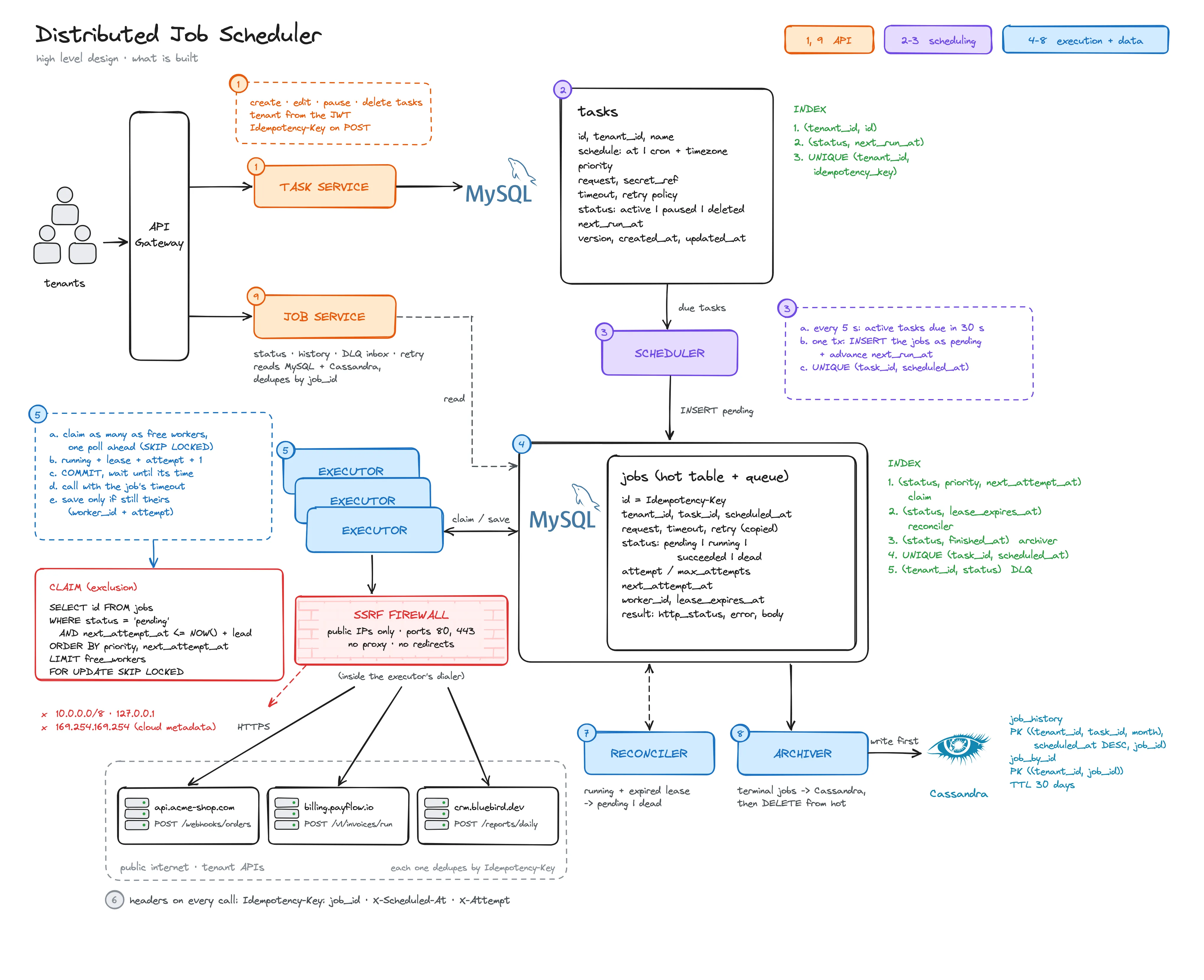
A distributed job scheduler: at and cron as a service. Tenants schedule HTTP calls to their own endpoints, once or on a cron expression, with priorities, automatic retries, a dead letter queue and a queryable history. It is designed for around a billion executions a day and built and load-tested at a much smaller scale.
Architecture
Six Go services, each hexagonal: a task API, a scheduler that turns due tasks into jobs, executors that claim jobs and call the endpoints, a reconciler for jobs whose executor died, an archiver that moves finished jobs to Cassandra, and a job API for status, history, the DLQ and manual retries.
There is no message broker. The jobs table in MySQL is the queue: executors claim rows with FOR UPDATE SKIP LOCKED, every state change is a conditional update, and attempt works as a fencing token so a late result can never overwrite a newer claim. Finished jobs move to Cassandra, written there first and deleted from MySQL second, so a crash leaves a duplicate and never a loss.
What I learned
- One source of truth beats a broker when the job has to live in the database anyway: no dual write, and
SKIP LOCKEDhands out work safely. - Nothing was lost in ten tests and about 260,000 jobs, including an executor killed mid-run and MySQL cut for 30 seconds.
- The 300 jobs/s ceiling was an N+1 of mine in the scheduler, one
UPDATEper task. One statement per batch took a tick of 1,000 tasks from 5.5 s to 54 ms. - Priority only orders what already exists. At the 09:00 peak, critical jobs were as late as everyone else.
What’s next
Running the capacity test again after the fix, then the parts of the design that are not built yet: a fast path for critical jobs, priority at the source, concurrency limits per tenant and scheduler partitions owned through a lease.
Write-ups
Nov 11, 2026
Building a distributed job scheduler without a queueat and cron as a service, in Go: six services, MySQL as the queue, Cassandra for history. The decisions behind it, their trade-offs, and what load-testing it on an AWS-shaped bench found, including a bug of mine.
Nov 11, 2026
Load-testing a distributed job scheduler on an AWS-shaped benchAn EKS and RDS lookalike on one PC, a cron platform with 30,000 jobs due at 09:00:00, and ten tests. Nothing was lost; the 300 jobs/s ceiling turned out to be an N+1 of mine.
Nov 11, 2026
Distributed job scheduler: the design decisions in depthWhy the jobs table is the queue, why MySQL and not Postgres, why Cassandra only for history, and how leases, fencing tokens and idempotency keys keep at-least-once honest. With the alternatives I rejected and the SQL behind each decision.